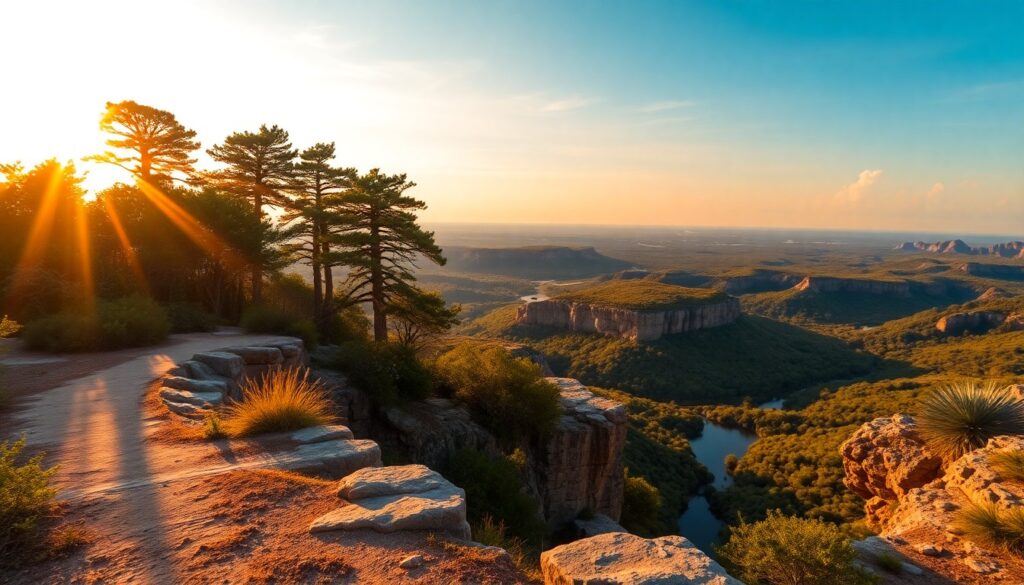
The crisp scent of pine needles, warmed by the South Florida sun, greets you as you step onto the Long Pine Key Forest Loop. Here, the unique crunch of limestone gravel beneath your boots harmonizes with the gentle rustle of saw palmetto, creating an immediate sense of wild immersion. Sunlight filters through the sparse canopy of South Florida slash pines, dappling the path and revealing the raw beauty of one of Florida’s rarest ecosystems. This isn’t the dense, humid jungle many associate with the Everglades; it’s a dry, ancient landscape waiting to be explored.
Trail Specifications
Trail Name: Long Pine Key Forest Loop
Location: Everglades National Park, Homestead, FL
Distance: Approximately 7 miles (Loop)
Elevation Gain: Minimal (Less than 50 ft)
Difficulty: Easy
GPS Coordinates: 25.378° N, 80.609° W (Long Pine Key Trailhead)
Best Season: Dry Season (November – April)
Dog-Friendly: No (Pets are not permitted on trails in Everglades National Park)
Route Overview & Natural Highlights
The Long Pine Key Forest Loop offers an unparalleled journey through a pristine pine rockland, a unique ecosystem found only in South Florida and the Caribbean. Your adventure unfolds on largely flat, well-maintained paths composed of crushed limestone and sand, making for comfortable walking. The terrain, while generally level, occasionally reveals the exposed, pitted surfaces of ancient Miami Limestone, testament to millions of years of geological formation. These karst features, including small solution holes, provide microhabitats for specialized plants and invertebrates.
Ecologically, the trail is dominated by the tall, slender South Florida slash pine (Pinus elliottii densa), whose needles carpet the ground. Beneath their canopy, a dense understory of saw palmetto (Serenoa repens) and coontie (Zamia integrifolia), a native cycad, thrives. Keep your eyes peeled for the distinctive burrows of the gopher tortoise (Gopherus polyphemus), a keystone species whose tunnels provide shelter for hundreds of other creatures. White-tailed deer (Odocoileus virginianus) are often spotted grazing in the more open areas, and the air is alive with the calls of various bird species, from woodpeckers drilling into pine trunks to warblers flitting through the undergrowth. During the cooler, drier months, a profusion of wildflowers like blazing star (Liatris species) and various orchids add splashes of color to the verdant landscape.
Turn-by-Turn Trail Breakdown
Trailhead Start: Into the Pinelands
Your journey begins at the clearly marked Long Pine Key Trailhead, adjacent to the campground. From the moment you step onto the path, you are enveloped by the distinct atmosphere of the pine rocklands. The trail here is wide and inviting, guiding you immediately into the dappled shade of the slash pines. Notice the subtle undulations in the ground, a gentle reminder of the underlying limestone bedrock. Within the first mile, you’ll pass several interpretive signs that offer insights into the fire-dependent nature of this ecosystem and the rare plant species it supports.
Mid-trail Features: Open Vistas and Wildlife Encounters
As you venture deeper into the loop, the trail occasionally opens into expansive clearings, offering wide-open views of the pine savanna stretching towards the horizon. These sun-drenched patches are excellent places to spot wildlife; gopher tortoises often bask near their burrows, and you might catch a glimpse of a swift black racer snake slithering through the grasses. The path remains generally flat, winding gently through denser stands of pine and more open palmetto prairies. Around the halfway point, the trail skirts the edge of a small wetland area, a temporary pond after heavy rains, which can attract wading birds and offer a brief change in scenery and vegetation.
The Loop’s Turn & Return: Reflective Journey
The Long Pine Key Forest Loop is a true loop, meaning there’s no singular “summit” or destination beyond completing the circuit. As you round the furthest point and begin your return, the perspective subtly shifts. You’ll notice details you might have missed on the outbound leg – a particularly gnarled pine, a vibrant butterfly (perhaps a zebra longwing or a swallowtail) fluttering among wildflowers, or the intricate patterns in an exposed limestone outcrop. The return journey offers a chance to reflect on the unique beauty of this resilient landscape, bringing you back to the trailhead feeling refreshed and connected to Florida’s ancient wilderness.
Seasonal Guide & Best Times
- Winter (November – February): This is the prime dry season and the absolute best time to visit. Temperatures are cooler, humidity is low, and mosquitoes are minimal. Wildlife is more active and visible, and the clear, sunny days are perfect for hiking.
- Spring (March – May): The dry season continues into spring, with increasing temperatures and humidity. Wildflowers are often abundant, especially in early spring. Mosquito activity begins to pick up towards May, but it’s still a pleasant time to hike, particularly in the mornings.
- Summer (June – August): The wet season brings daily afternoon thunderstorms, high heat, and intense humidity. Mosquitoes are prolific and relentless. Hiking is challenging and less enjoyable during these months, though early morning starts can offer brief windows of opportunity.
- Fall (September – October): A transitional period. While still warm and wet, the frequency of heavy rains may begin to decrease towards late October. Humidity remains high, and mosquitoes persist. Conditions slowly improve as the dry season approaches.
Essential Gear & Safety
- Water: Carry ample water, especially during warmer months. There are no refilling stations on the trail.
- Sun Protection: A wide-brimmed hat, sunglasses, and sunscreen are essential. The pine canopy offers limited shade in many areas.
- Insect Repellent: Absolutely crucial, particularly outside of the dry season. Mosquitoes can be severe.
- Sturdy Footwear: Closed-toe shoes with good ankle support are recommended for the uneven limestone and sandy sections.
- Navigation: While the trail is generally well-marked, carrying a map or using a GPS-enabled app like AllTrails can provide peace of mind.
Getting There & Parking
The Long Pine Key Forest Loop is located within Everglades National Park, approximately 10 miles west of the Ernest Coe Visitor Center. From Homestead, Florida, take State Road 9336 (Main Park Road) into the park. Continue past the visitor center for about 6 miles, then turn left onto the road leading to the Long Pine Key Campground. The trailhead and ample parking are located just before the campground entrance. An entrance fee to Everglades National Park is required. The park is open 24 hours a day, year-round, though visitor center hours vary seasonally.
Curated Literature & Miami Downtown Calendar
The Architecture of Focus: Deep Work & Modern Mastery
By Founders Library Press
A structured framework for strategic clarity, productivity, and authentic execution.
Upcoming Downtown Happenings
Live acoustic sessions, gallery receptions, literary salons, and independent trade shows across Miami.
